

"This work investigates the kinetics of the enantioselective transesterification of ethyl butyrate and (R)-2-pentanol in a solventless medium biocatalyzed by Novozym435, an immobilized Candida antarctica Lipase B. A reaction-diffusion reversible Ping-Pong bi-bi model was developed to represent the reaction rate with additional estimation of the internal mass transfer using an orthogonal collocations method. A total of 18 experiments (774 data points) were conducted in the SpinChem Vessel V2 batch reactor at a constant stirring speed of 400 rpm, varying temperatures, initial molar fractions, catalyst ratio, and size fraction. Kinetics data were fitted using the model, resulting in optimized kinetic parameters, which align with expected Ping-Pong Michaelis-Menten mechanisms. Values for the effectiveness factor for intraparticle mass transfer diffusion vary between 0.37 and 1, indicating the need to include mass transfer considerations in kinetic modeling."
Keywords
#kineticmodeling, #transesterification, #MichaelisMenten, #Novozym435, #enzymaticreaction, #massTransfer
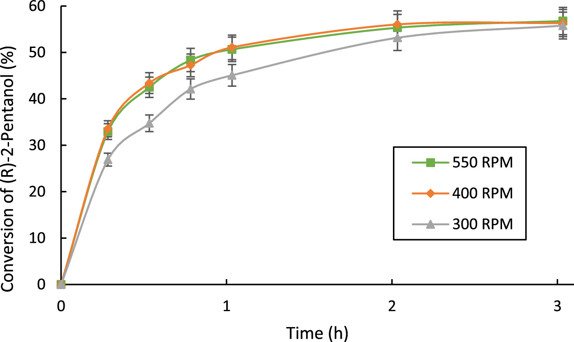
L2417 Effect of Stirring Speed on Transesterification Conversion in SpinChem RBR
Highlights:
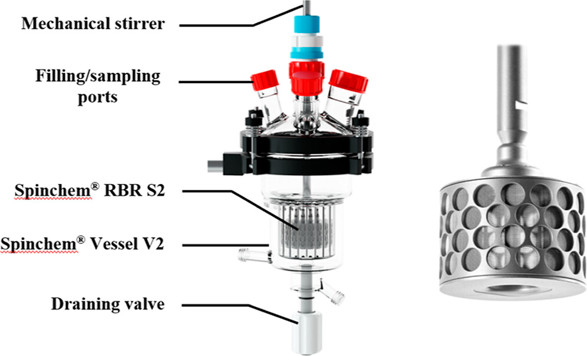
- The study demonstrates the effectiveness of the SpinChem RBR S2 + Vessel V2 in facilitating enantioselective transesterification reactions catalyzed by Novozym 435.
- Using a Ping-Pong bi-bi model, researchers examined the reaction rates with considerations for internal mass transfer.
- “External mass transfer limitations were found nonlimiting for stirring speeds higher than 400 rpm"
- This research highlights the importance of the role of the SpinChem reactor in supporting sustainable, scalable processes in biocatalysis.
Authors & Research Group
This research was conducted by the Laboratory of Catalysis, Polymerization, Processes and Materials (CP2M) at Université Claude Bernard Lyon 1 and CPE Lyon in Villeurbanne, France, bringing together expertise in catalysis, enzymatic reaction engineering, and process intensification.
Nicolas Chaussard (LinkedIn)
Clémence Nikitine (LinkedIn)
Pascal Fongarland (LinkedIn)