
From Lab to Production
Reading time: 3-4 minutes
Original article on Linked in

We hear the same challenges from teams working on enzyme-based processes. Lab results look promising, but production economics don't work. You need enzymes that stay active through multiple cycles. Materials that meet both performance and regulatory requirements. Mass transfer that doesn't limit your throughput. Scale-up paths that maintain yield and selectivity.
So we put together this collection of research that tackles exactly those problems. These teams documented solutions with real performance data and cost breakdowns you can use, whether you're scaling up, optimizing an existing process, or choosing better materials.
Highlights of this issue:
-
How can you cut pharmaceutical production costs by 38% while reducing waste?
-
What if biodegradable enzyme carriers actually outperformed the plastic beads you're using now?
-
From 25 kg to 7 kg waste: How process optimization delivers cleaner chemistry at scale?
-
How do you achieve 12x faster reaction rates while using 87% less oxygen?
Making medicine affordable without compromise
When COVID-19 hit, the Medicines for All Institute faced a challenge many of us know well: how do you scale up production quickly while keeping costs down and maintaining quality?
Their molnupiravir synthesis work showed what's possible when you can reuse enzymes reliably. By recycling the enzyme three times in a rotating bed reactor, they dropped raw material costs from $260/kg to $160/kg. That's a 38% reduction, with simultaneous waste reduction.
This is the kind of result that matters when you're trying to make quality medicine accessible.
"We used SpinChem S2 reactor to make an anti-covid drug. S2 allowed us to use a protected enzyme in the process without disturbing the enzyme at all. It worked for several batches with no addition of new enzyme."
G. Michael Laidlaw, Director at VCU/Medicines4All
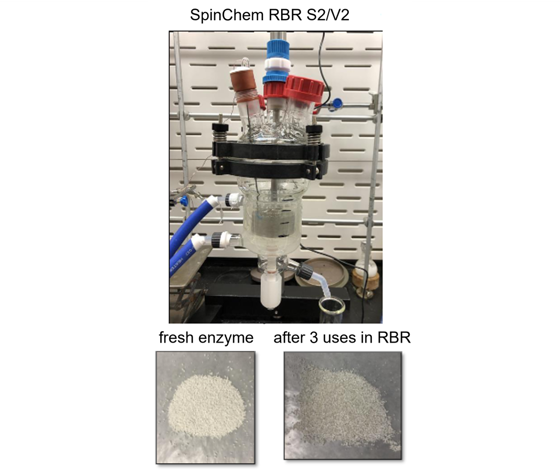
Enzyme Stability Comparison in SpinChem RBR System
When biodegradable actually means better performance
Environmentally persistent polystyrene and polyacrylic beads are currently the standard for large-scale enzyme immobilization in industrial bioprocesses—from high-fructose corn syrup production to pharmaceutical API synthesis. The assumption has been that these synthetic polymers are necessary for reliable performance.
Researchers at from Department of Chemical Engineering, University of Bath, together with industrial process development specialists from ChiralVision and Naturbeads challenged that assumption. Their diaminated cellulose beads didn't just match conventional acrylic beads, they outperformed them, with activity of 588 U/g versus 459 U/g after 12 reaction cycles.
For operations teams facing microplastic contamination concerns and tightening regulations, this research validates that biodegradable alternatives can outperform the materials currently in use.
How process optimization delivers cleaner chemistry at scale
Scaling up is where a lot of promising chemistry falls apart. What worked beautifully at 120 mL suddenly doesn't translate when you move to production volumes.
Researchers at Aarhus University and Sustainable Momentum SL demonstrated how this jump happens in practice with their bio-based styrene derivative synthesis study. They scaled from 120 mL to 10 L while improving efficiency, maintaining over 95% yield and reducing waste to just 7 kg per kg of product (and 13 kg CO₂ emissions).
This demonstrates that scale-up doesn't have to mean compromise. With the right reactor design and process control, you can maintain lab-scale performance at production volumes while keeping environmental impact low.
Tiny bubbles, big difference
Oxygen-limited reactions are frustrating. You're pumping in gas, but your reaction rate stays stuck because you can't get enough oxygen into solution.
Researchers at Institute of Technical Biocatalysis, Institute of Multiphase Flows, Hamburg University of Technology (TUHH) looked at bubble size. Turns out it matters—a lot. Their work with fine bubble aeration in rotating bed reactors showed reaction rates 12.9 times faster than with regular bubbles. And here's the bonus: they used 87.5% less oxygen to get there.
The enzyme remained stable, delivering 96.5% reaction yield with consistent activity across multiple batches.
If you're in food and beverage production working with gluconolactone or similar ingredients, this approach gives you both sustainability wins and better process efficiency. Not a bad combination.
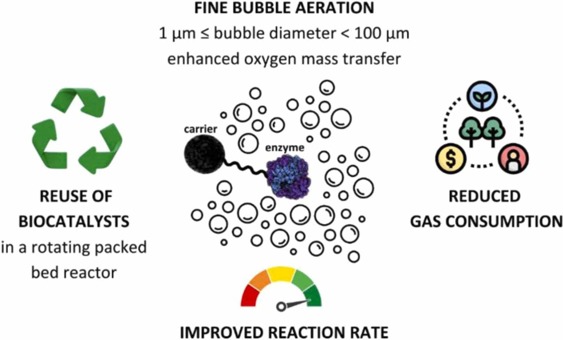
L2404 Fine Bubble Aeration Benefits in Rotating Bed Reactors
Each of these research teams tackled a different problem, but the pattern is similar: they combined good chemistry with production-ready reactor systems and documented results you can replicate.
If you're working on enzyme-based processes or heterogeneous catalysis and wondering how to move from proof-of-concept to something scalable, these examples show different approaches that worked.
Further reading
-
An introduction to enzyme-based reactions and how rotating bed reactors enable industrial-scale biocatalysis Biocatalysis: A sustainable approach to chemical synthesis
- Biocatalysis offers pharmaceutical and chemical manufacturers a path to greener production, but high enzyme costs have limited adoption. This challenge is solved by enabling reliable enzyme reuse across multiple production cycles, making sustainable chemistry economically viable.
Have questions about implementing these approaches in your process?
Contact Erik Löfgren or Emil A. Byström to discuss your application.