What biocatalysis, remediation, and process development teams are learning as they move from screening to day-to-day use
Hi, Erik Löfgren and Emil Byström here, CTO and CEO of SpinChem, working on technical solutions for global process industries.
We've recently launched the new SpinChem® MiniRBR and are now collecting the most important questions and real-world results from labs using the system.
How it started: the screening challenge that shaped MiniRBR
Over the past years, we've had the same conversation with many lab teams across biocatalysis, remediation, and process development. It always starts with a practical constraint: "We need to screen a large number of conditions, but we can't afford to run 100+ mL per test when substrate costs add up fast." On top of that, the workflow needs to be as easy as possible; the handling of materials and the work-up.
The MiniRBR was built to address those exact pain points. User-fillable rotating bed reactors that work in volumes as low as 5 mL. A technology that delivers the mass transfer teams need to see real activity, while replicating the larger-scale implementations (making the magnetic stir bar obsolete). Once conditions are dialed in, transfer to larger RBR models is done with confidence that the insights will scale.
What the research tells us
Around a 50% uplift in apparent activity versus suspended carriers under comparable conditions, linked to improved mass transfer in the rotating bed.
Stable behavior across typical lab ranges and a clean scale-down of RBR behavior for screening.
A practical fit for immobilized enzymes, adsorbents, and scavengers that should be separated from the liquid afterwards.
What are the main advantages of using the MiniRBR versus other lab tools?
The SpinChem® MiniRBR is particularly useful for:
Immobilized biocatalysis when mass transfer limits conversion.
Multi-solid workflows that benefit from compartmentalization to avoid catalyst incompatibilities.
Adsorption tasks such as color removal or scavenging where consistent bed contact improves outcomes.
That said, we know that every lab has its own challenge—and we're always curious to hear about edge cases or new applications. If your setup doesn't fit the typical biocatalysis or adsorption mold, reach out. We'd love to help you explore whether the MiniRBR can help.
FAQs we received during the last few weeks:
Can I change the pore size? It's a fixed 36 μm.
How much solid can I load in the MiniRBR? Up to ~1–1.5 mL of solids. Make sure to account for swelling if you load dry materials. Preconditioning the solid phase is often a good idea.
Will solid products pass the filter? Typically no, but pore blockage can occur with crystallization or agglomeration—watch supersaturation and consider pre-conditioning.
Is this reactor suitable for viscous liquids? Mostly yes; very viscous systems may favor larger RBR units.
How does this reactor handle pH extremes and solvents? Polyamide works in many common solvents and reaction conditions, but extreme pH and certain solvents can cause degradation or swelling. If you are unsure, validate with a chemical compatibility chart before long runs.
Can the SpinChem® MiniRBR be used multiple times? Yes, when it's applicable to your process. The Mini-RBR can be refilled and reused multiple times (a key improvement over the previous disposable MagRBR version). Please note that it cannot be washed warmer than 70°C.
Buying options at a glance
All MiniRBR options are available for purchase through our online store; no contact needed, just select your products and check out.
Single units for quick trials.
Packs of six for parallel runs
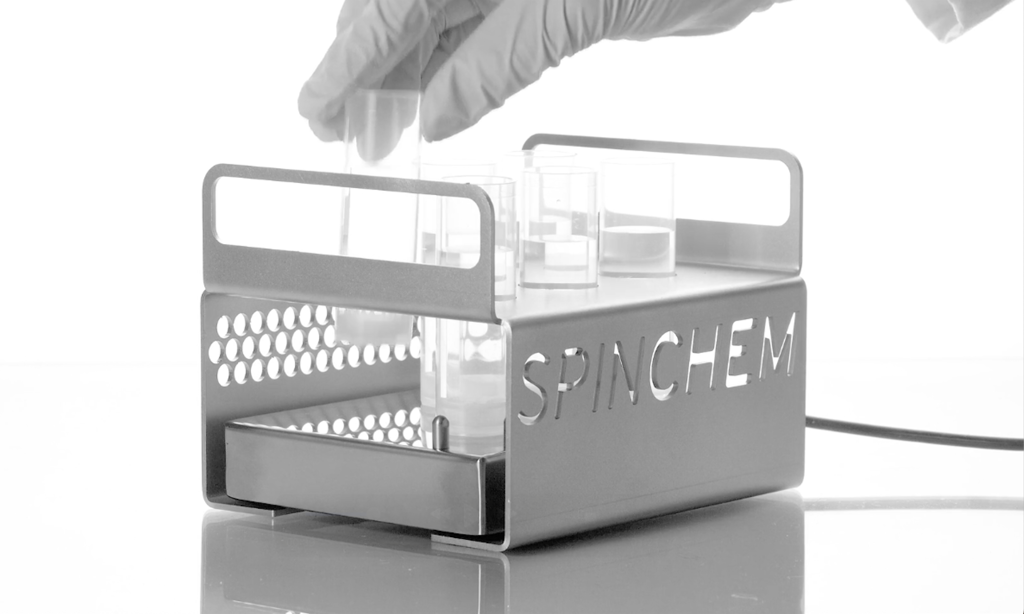
A complete starter kit with stirrer and MiniRBRs for parallelized reactions.