This research introduces a sustainable method for producing diaminated cellulose beads (DAB) as enzyme carriers, offering an eco-friendly alternative to conventional polystyrene or polyacrylic beads used in industrial bioprocesses like glucose isomerization, lactose hydrolysis, and pharmaceutical synthesis.
"Environmentally persistent polystyrene or polyacrylic beads are used as supports in enzyme large-scale bioprocesses, including conversion glucose isomerization for high-fructose corn syrup production, hydrolysis of lactose, and synthesis of active pharmaceutical ingredients. In this paper, we report the development of a novel sustainable and scalable method to produce diaminated cellulose beads (DAB) as highly efficient alternative supports for industrially relevant lipases. Regenerated cellulose beads were grafted with diaminated aliphatic hydrocarbons via periodate oxidation and reductive amination. The oxidation step indicated that aldehyde content can be easily tuned through the reaction time and concentration of reactants. Reductive amination of dialdehyde cellulose was more efficient as the length of the diaminated hydrocarbon compound increased..."
Highlights:
The study explores diaminated cellulose beads (DAB) as a biodegradable alternative to synthetic polymer supports for enzyme immobilization. Findings show that DAB, particularly when using Thermomyces lanuginosus lipase (TLL), retain high activity and recyclability in biocatalytic reactions. Tests in a rotating bed reactor (SpinChem) demonstrate superior performance of cellulose-based beads over conventional acrylic carriers, with promising applications for reducing microplastic pollution in industrial processes.
- "Biodegradable cellulose-based materials could be a valid and attractive alternative to plastics carriers."
- "In a direct comparison, TLL immobilized on DAB achieved higher activity in MCT hydrolysis than on traditional acrylic beads."
Key performance metrics from SpinChem reactor trials demonstrate that:
- 100% enzyme adsorption efficiency was achieved with TLL on 1,6-DAB (vs. lower rates on unmodified cellulose)
- 588 U/g activity in MCT oil hydrolysis surpassed acrylic bead performance (459 U/g) by 28%
- Superior binding strength in biphasic water-oil systems prevented enzyme desorption—a common failure mode for conventional supports
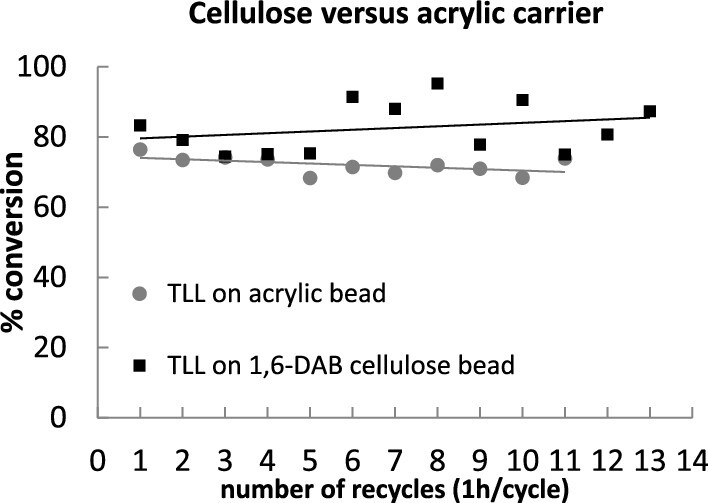
L2418 Comparison activity on cellulose beads versus acrylic beads
"After 12 cycles the lipase remained stable in the cellulose beads and reached higher conversion and activity (87%, and 588 U/g respectively) than the same enzyme immobilized on conventional acrylic beads (68%, and 459 U/g respectively)."