

"The global pharmaceutical industry, despite its growth, faces challenges in drug development, characterized by extensive timeframes and high costs. A significant bottleneck in this process is the labor-intensive and inefficient experimental synthesis in medicinal chemistry. The transition to automated methods offers a solution to these challenges, promising enhanced efficiency, scalability, and safety, while significantly reducing time and costs. This paper presents the development of an automated rotating bed reactor as part of an intelligent Cyber-Physical System-based automated drug discovery workcell. The automated rotating bed reactor is designed to be easily integrated as a component in the workcell, aiming to enable rapid adaptation to meet the specific needs of on-demand drug production. Experiments with the system show that it has the potential to enhance the yield of chemical reactions."
Keywords:
#automatedDrugDiscovery, #cyberPhysicalSystem, #pharmaceutical, #rotatingBedReactor, #drugDevelopment, #SpinChem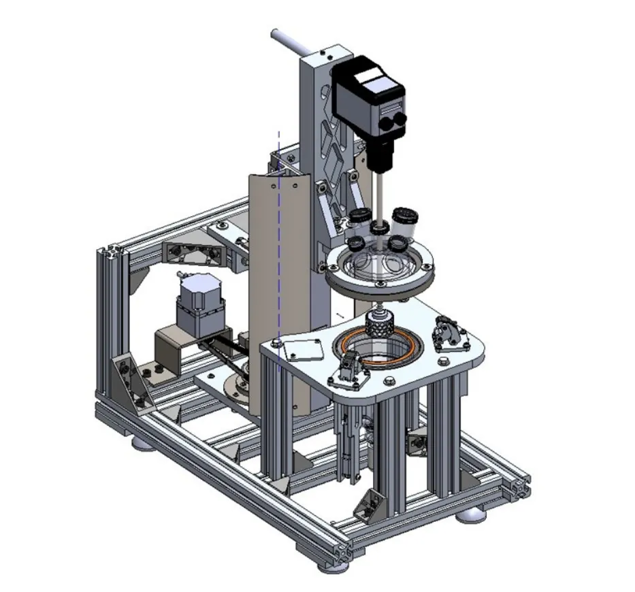
Highlights:
This paper explores the development of an intelligent, Cyber-Physical System (CPS)-based drug discovery workcell that includes a rotating bed reactor (RBR) designed to enhance efficiency in the pharmaceutical industry.
- The RBR provides benefits such as higher reaction yields, reduced time, and cost-effective production in small batches, which are essential for agile drug development.
- This approach has potential applications in on-demand production and could be adapted to meet varied drug production needs.
- SpinChem's RBR technology is mentioned for its unique advantage in handling solid-liquid reactions efficiently, contributing to advancements in automated synthesis.
Authors & Research Group
This research was conducted by an interdisciplinary team at the National University of Singapore (NUS), bringing together expertise in mechanical engineering, robotics, automation, and organic chemistry.
Principal Investigator:
Chin-Boon Chng – Research Fellow, Department of Mechanical Engineering, NUS. Specializes in robotics, control engineering, and medical devices. Google Scholar
Team Members:
Konstantin Koenig – Department of Mechanical Engineering, NUS. ResearchGate
Pooi-Mun Wong – Department of Mechanical Engineering, NUS. ResearchGate | Google Scholar | Personal website
Mu Wang – Department of Chemistry, NUS. LinkedIn | ResearchGate
Jie Wu – Associate Professor, Department of Chemistry, NUS. Dean's Chair Professor (2023–2026). Specializes in organic synthesis and flow synthesis.
Chee-Kong Chui – Associate Professor, Department of Mechanical Engineering, NUS. Specializes in medical devices, robotics, and computer-aided surgery. Google Scholar
SpinChem Perspective
The work by Chng and colleagues at NUS addresses one of the most persistent bottlenecks in drug development: the manual, time-consuming nature of solid-liquid phase synthesis. For pharmaceutical companies working on complex API routes, where reactions involve solid-supported reagents or polymeric resins, continuous-flow systems simply cannot handle the solid by-products without clogging. The rotating bed reactor solves this by keeping the solid reactant precisely contained while maintaining constant fluid exposure through rotation, enabling automated multi-step sequences without manual intervention between steps.
This has direct relevance for teams scaling on-demand drug production, where small-batch agility matters more than throughput volume. The demonstrated synthesis of enzalutamide, a widely used prostate cancer treatment, shows the RBR can deliver results comparable to or better than conventional reactors while being fully automatable. For the broader specialty chemicals and fine chemicals sectors, where heterogeneous reactions with solid catalysts or resins are routine, the ability to integrate an RBR into a Cyber-Physical System framework opens the door to intelligent, self-configuring production workcells that reduce manual labor and improve reproducibility.
What makes this particularly interesting is the modular design approach. The automated RBR was built around the SpinChem RBR S2 and designed for seamless integration with robotic arms and continuous-flow modules, meaning it can slot into existing automated workflows rather than requiring a complete overhaul of laboratory infrastructure.
—Erik Löfgren, CTO, SpinChem AB