Definitions and Types of Immobilization
Already from its beginnings, enzyme immobilizaton was undestood as:
“The term ‘immobilized enzymes’ refers to ‘enzymes physically confined or localized in a certain defined region of space with retention of their catalytic activities, and which can be used repeatedly and continuously.”
- T. Tosa, T. Mori, N. Fuse, I. Chibata, Enzymologia. 1966, 31(4), pp. 214-224.
Immobilization is the confinement of enzymes to another phase than the phase of the substrate and product. This overwhelmingly refers to enzymes attached to a solid phase of synthetic or natural origin and a surrounding solution holding substrate and product. However, other approaches such as gel-entrapped enzymes or cross-linked enzyme aggregation are available to generate the heterogeneous biocatalyst phase, but more on this below.
Generally, the process of attaching enzymes to an inert and insoluble material is termed 'enzyme immobilization'. The most prevalent chemical strategies to attain this employ either adsorption, ionic interactions, covalent binding, or entrapment methods.
Adsorption
Here enzymes bind to an inert carrier such as activated charcoal, silica or clay. Adsorptive binding can be enabled via a range of different weak attractive forces such as hydrogen bonding, van der Waals forces, or hydrophilic interactions. Because of these weak attractive forces the enzyme activity is typically not affected too much, however, changing pH, ionic strength, and temperature might affect binding and cause enzyme leaching.
Ionic interactions
For this, the isoelectric point of an enzyme, the pH of the solution and the surface functionality of the carrier resin have to play in concert to enable enzyme immobilization via ionic interactions. Hereby essentially any ion exchange resin can serve as solid carrier support as long as their positive or negative surface charge matches the complementary surface charge of the enzyme under given immobilization/reaction conditions.
Covalent binding
Amongst support-dependent immobilization strategies this option provides the stronges interaction between enzyme and carrier/support. While physical adsorption or ionic interactions between enzyme and carriers are comparatively weak and thus prone to activity losses due to enzyme leaching, covalently bound enzyme is much more resilient. At the same time this less reversible immobilization methodology complicates the material reuse of consumed enzyme carriers. As such, any immobilization strategy has to be selected based on process constraints, recycling objectives and restrictions, and cost contributions from the enzyme, the carrier, and the immobilization step.
Entrapment
Contrary to above techniques, this method relies on the formation of cross-linked networks of polymers around enzymes which physically compartmentalizes them and simultaneously preserves catalytic functionality.
Cross-linking
Another option is provided by cross-linking the enzymes themselves using multi-functional linker agents that allow generate an extensive network of enzymes, which - at a sufficient size - form heterogeneous biocatalyst precipitates in which the catalyst basically acts as its own carrier. Those preparations are widely known as cross-linked enzyme aggregates, short CLEAs.
Classification of Immobilized Enzymes
In general, enzymes can be divided into two categories, "native enzymes" and "modified enzymes". Immobilized enzyme preparations must be attributed to the modified enzymes class and can be further classified as either "support immobilized enzymes", "entrapped immobilized enzymes", or "cross-linked enzymes".
Advantages of Immobilized Enzymes
In many cases, immobilized enzymes have proven to be highly efficient for commercial applications. Synthetically relevant characteristics of immobilized and soluble enzymes can differ strongly, which often translates into desirable vantages of immobilized enzymes.
Typical advantages of immobilized enzymes over soluble enzymes include:
- increased enzyme stability
- increased total turnover
- reduced specific enzyme costs
- facilitated enzyme separation and recovery for reutilization
- enabled continuous process operations
- simplified product separation
- reduced effluent problems
- in some cases: increased activity.
Immobilized enzymes may exhibit selectively altered chemical or physical properties, as well as provide a better environment for enzyme activity. As a result, immobilized enzymes are frequently more stable than free enzymes in solution.
Applications of Immobilized Enzymes
Immobilized enzymes are already widely used in the pharmaceutical, chemical, food, and cosmetics industries. However, it is safe to predict that the use of biocatalysts will grow in the future. We at SpinChem can provide applications of immobilized enzymes in highly efficient rotating bed reactors.
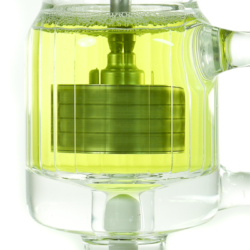
Get in touch for more information on how an RBR can be used to efficiently use your enzymes, and we will assist you in selecting the best system for your application.

