

"This study demonstrated the advantages of the rotating bed reactor (RBR) over the conventional turbine stirred tank reactor (TSTR) for enzymatically catalyzed biodiesel synthesis using D311-resin immobilized lipase. Integrating simulation and experimental analyses, the work revealed that the rotating bed generated significantly lower shear forces compared to the turbine stirred paddles, thereby preserving lipase integrity and enhancing reusability. Simulations identified tangential velocity—modulated by rotational speed and bed porosity—as the dominant factor governing hydrodynamic velocity and liquid-solid mass transfer coefficients. Experimental validation confirmed these findings: Under optimized conditions, the yield of the fatty acid methyl esters (FAMEs) decreased from 87.49 % to 60.33 % after continuous use of immobilized lipase for 48 cycles in the RBR. In contrast, TSTR systems exhibited accelerated activity loss (≤69.9 % retention after 9 cycles) and yield deterioration (60.3 %). By mitigating shear-induced lipase deactivation and optimizing mass transfer, RBR technology paired with D311-resin immobilized lipase offers a scalable, cost-effective strategy for industrial biodiesel production."
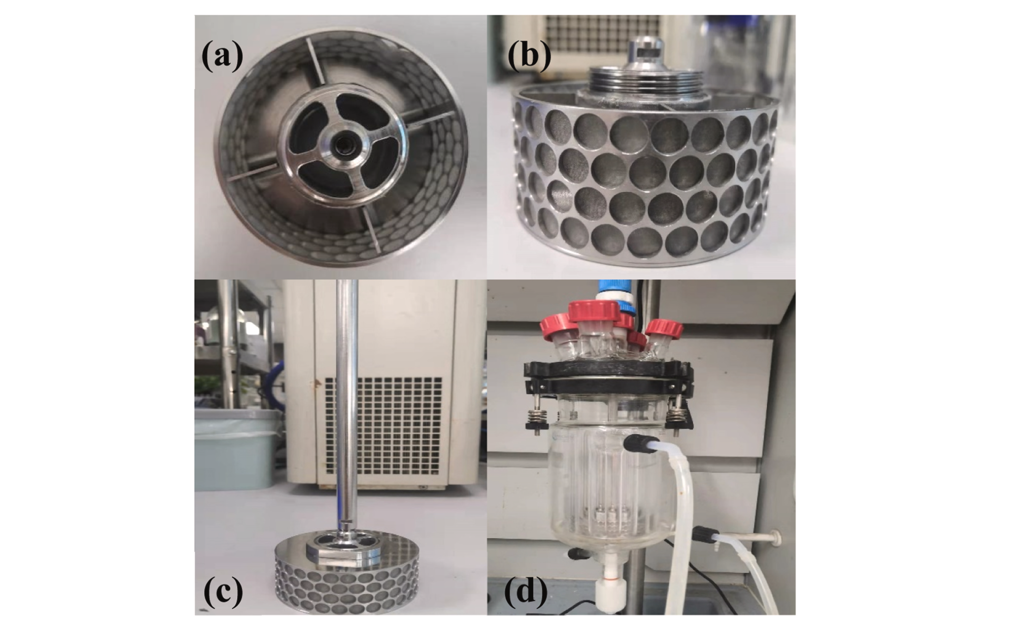
Image 1. Application L2505. Structural diagram of the RBR: (a) internal structure of the RBR, (b) external structure of the RBR, (c) the RBR connected with the mixing shaft, (d) SpinChem Starting Kit S2
Highlights:
- Longer immobilized-enzyme usability in RBR vs TSTR: In the study’s “optimized conditions”, the FAME yield in the RBR decreased from 87.49% to 60.33% after 48 cycles of continuous use. In contrast, the turbine stirred tank reactor (TSTR) showed accelerated activity loss (≤69.9% retention after 9 cycles) and yield deterioration (60.3%).
- Lower shear environment supports enzyme integrity: The rotating bed generated significantly lower shear forces than turbine stirred paddles, helping preserve lipase integrity and enhance reusability.
- Mass transfer drivers clarified: Simulations identified tangential velocity (modulated by rotational speed and bed porosity) as a dominant factor governing hydrodynamic velocity and liquid-solid mass transfer coefficients, and experiments validated the findings.
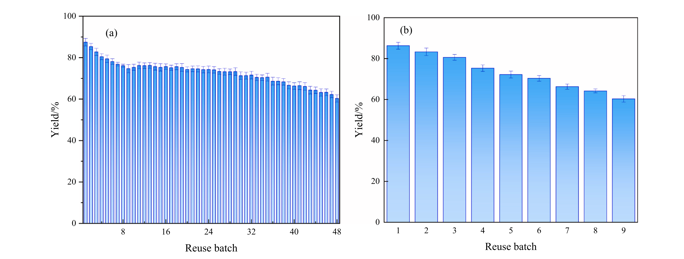
L2505. Image 2. Reuse of the D311 resin immobilized lipase under the optimal reaction conditions: alcohol to oil molar ratio 3, water content 0 wt%, rotating speed 600 rpm, reaction temperature 35℃, enzyme dosage 10 wt%, reaction time 9 h, methanol addition at 0 h, 3 h and 6 h respectively: (a) in the RBR; (b) in the TSTR.
Authors & Research Group
This research was conducted by an international collaboration between SINOPEC Research Institute of Petroleum Processing Co., Ltd in China and Beijing University of Chemical Technology in China, bringing together expertise in petroleum processing, biocatalysis, and biochemical engineering.
Principal Investigator:
Meng Wang (Corresponding Author) – College of Life Science and Technology, Beijing University of Chemical Technology, specializing in enzymatic catalysis and biofuel production
Research Team:
- Shuai Huang – SINOPEC Research Institute of Petroleum Processing Co., Ltd (First author, experimental design and CFD simulation)
- Haoyuan Tan – Beijing University of Chemical Technology (Data curation)
- Luxuan Sun – Beijing University of Chemical Technology (Methodology)
- Biqiang Chen – Beijing University of Chemical Technology (Resources)