Application L2502

Intensified, Kilogram-Scaled, and Environment-Friendly: Chemoenzymatic Synthesis of Bio-Based Acylated Hydroxystyrenes

Philipp Petermeier, Pablo Domínguez de María, Emil Byström, Selin Kara

ACS Sustainable Chem. Eng. 2024, 12(34), 12869−12878

“… Herein, we demonstrate the production of 1 kg of 4-acetoxy-3-methoxy-styrene in a 10 L reactor and present practical adjustments to the up- and downstream processing that warrant a straightforward process and high isolated yields. Additionally, an environmental assessment is conducted, … the total CO2 production of the process is studied, including contributions from energy use and the treatment of generated wastes. … Overall, the holistic assessment of the process, its optimization, scale-up, product isolation, and environmental analysis indicate the feasibility of multistep chemoenzymatic reactions to deliver high-volume, low-value chemicals from biorefineries.”

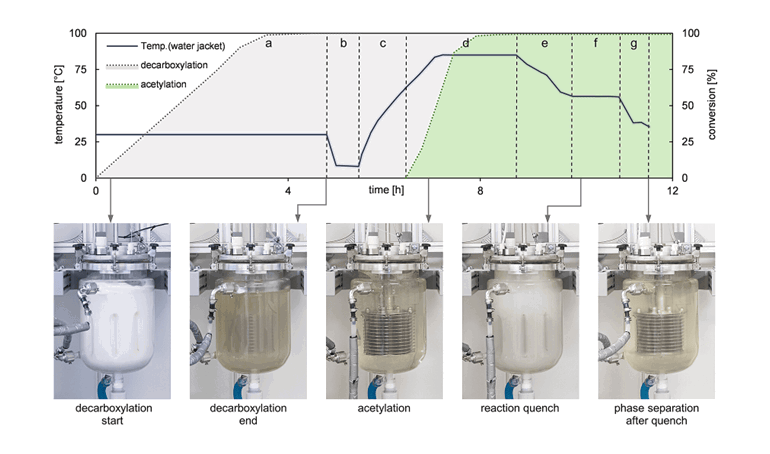
A graph showing temperature and conversion data over a 12-hour reaction process, with three plotted lines: water jacket temperature, decarboxylation, and acetylation rates. Below are five photographs showing the reaction progression in a reactor vessel, from initial decarboxylation (white mixture) through to final phase separation, demonstrating visual changes in the mixture from clear to brown, followed by mixing, quenching, and final separation into distinct layers.

The image shows a graph with temperature and conversion data over time, accompanied by a series of five reactor photographs showing different stages of the process. The graph displays three lines: temperature (water jacket), decarboxylation, and acetylation, plotted against time over approximately 12 hours. Below the graph are five photographs of a reactor vessel showing the visual progression of the reaction from Decarboxylation start to Phase separation after quench

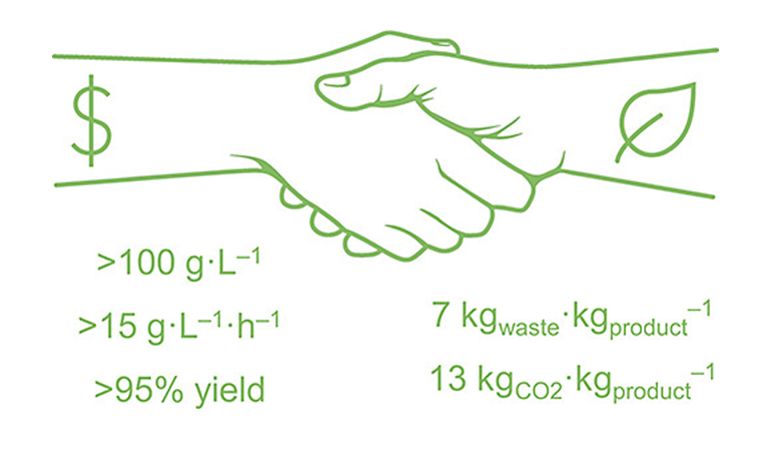
Key performance metrics of the kilogram-scale chemoenzymatic synthesis, combining economic viability with environmental considerations

Keywords: reaction cascade,styrene alternatives,carbon dioxide equivalents,green solvents,phenolic acids,polymer precursors

Highlights:

  • “The reaction cascade was conducted on a 120 mL lab scale using the SpinChem rotating bed reactor S2 in a 200 mL baffled glass reactor”
  • “Once the refined workup procedure was demonstrated on the lab scale, the reaction cascade was conducted on a 10 L scale to produce 1 kg AMS in a single batch.”
  • “Promising environmental metrics of the kilogram-scaled system, based on the E factor and the total CO2 released.”

Authors & Research Group

This research was conducted by an international collaboration between Aarhus University's Department of Biological and Chemical Engineering in Denmark, Sustainable Momentum SL in Spain, and SpinChem AB in Sweden, bringing together expertise in biocatalysis, industrial green chemistry, and rotating bed reactor technology.

Principal Investigator:

Prof. Selin Kara - Department of Biological and Chemical Engineering, Aarhus University, Denmark

Research focus: Biocatalysis, sustainable chemistry, and process intensification (ORCID Profile)

Research Team:

Philipp Petermeier – Department of Biological and Chemical Engineering, Aarhus University (Linked in)

Pablo Domínguez de María – Sustainable Momentum SL, Spain; specializing in industrial biocatalysis and green chemistry (LinkedIn)

Emil Byström – SpinChem AB, Sweden; CEO and expert in rotating bed reactor technology (LinkedIn)