

"Conventional enzyme immobilisation often relies on chemical crosslinkers that can compromise biocompatibility and activity. This study introduces a crosslinker-free strategy for biomaterial functionalisation that exploits the reversible self-aggregation of the p40 domain from Caldibacillus cellulovorans. Inclusion bodies of p40-fusion proteins were solubilised with guanidinium hydrochloride and reaggregated onto diverse matrices, including polypropylene fibres, cellulose fabrics, and porous beads, forming stable enzyme-functionalised surfaces under mild aqueous conditions. Fluorescent mCherry p40 fusions confirmed uniform reaggregation and matrix attachment, demonstrating the versatility of the approach across material types. The method achieved functionalisation efficiencies of 82–100%, while catalytically active p40–enzyme inclusion bodies retained 75–100% of their initial activity following matrix functionalisation. α-Amylase p40-functionalised polypropylene fibres maintained full catalytic activity for twelve reaction cycles at 70 °C and approximately 50% at 80 °C, while tagatose 4-epimerase p40-functionalised matrices demonstrated proof-of-concept applicability in a SpinChem® rotating bed reactor, supporting D-tagatose formation over ten cycles. Fourier transform infrared analyses indicated β-sheet-rich secondary structures consistent with ordered, functional aggregates. These findings show that β-sheet-mediated, reversible aggregation of p40 inclusion bodies provides a robust, scalable, and sustainable route for producing highly stable enzyme–matrix assemblies, offering a general platform for industrial biocatalysis and other biofunctional material applications."
Keywords
EnzymeImmobilisation #Biocatalysis #RotatingBedReactor #SustainableBiomaterials #BiofunctionalSurfaces #SelfAggregation
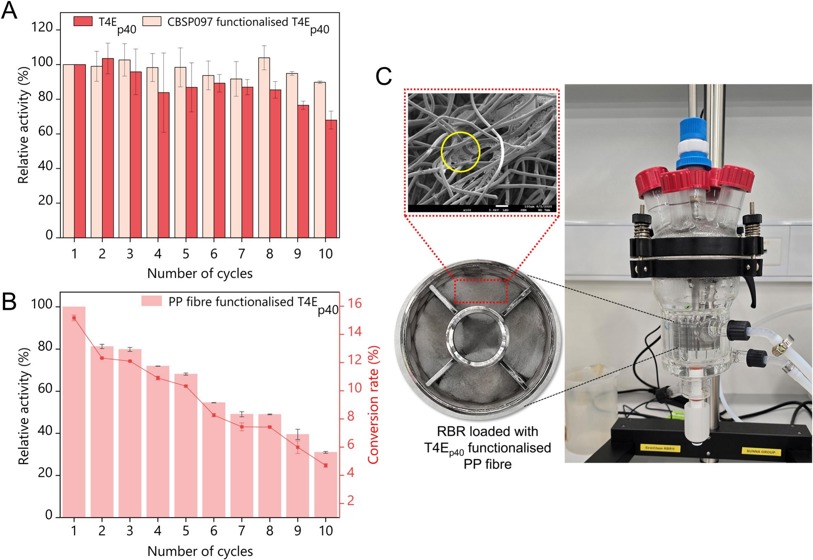
Image 1. (A) Reuse of free and bead-functionalised T4E~p40~ over 10 cycles. (B) Activity and conversion of T4E~p40~-functionalised PP fibre in a SpinChem® RBR S2 over 10 cycles. (C) SEM of PP fibre, loaded RBR basket, and assembled reactor. Vijayakumar & Sunna, Int. J. Biol. Macromol., 2026, 349, 150562.
Highlights:
- Crosslinker-free immobilisation with exceptional activity retention. p40-mediated self-assembly achieved 82–100% functionalisation efficiency and 75–100% activity retention across diverse matrices (polypropylene fibres, cellulose fabrics, porous beads), eliminating chemical crosslinkers that compromise enzyme performance.
- Industrial-grade operational stability. α-Amylase-functionalised polypropylene fibres maintained 100% catalytic activity over 12 reaction cycles at 70 °C and ~50% at 80 °C, demonstrating robust reusability without covalent attachment.
- SpinChem® RBR S2 proof-of-concept. Tagatose 4-epimerase-functionalised PP fibres in a SpinChem® RBR S2 (four-compartment basket, 80 °C, 800 rpm) achieved 16% D-tagatose conversion with yields of 0.75–0.23 g/l over 10 consecutive cycles (~24 h), confirming the p40-assembled layer withstands hydrodynamic stress during rotation.