)

Enzyme Technology Alliance (ETA)

Estimated reading time: 3-4 min

Last year, SpinChem joined the Enzyme Technology Alliance — a group of seven global companies, collaborating to bring competitive solutions for protein development processes to market at scale.

Transforming biotech through collaboration

The Enzyme Technology Alliance was established to replace harmful processes with environmentally friendly alternatives, benefiting not just a more sustainable industry but also enabling companies to improve their production profitability. It comprised seven small to medium-sized companies.
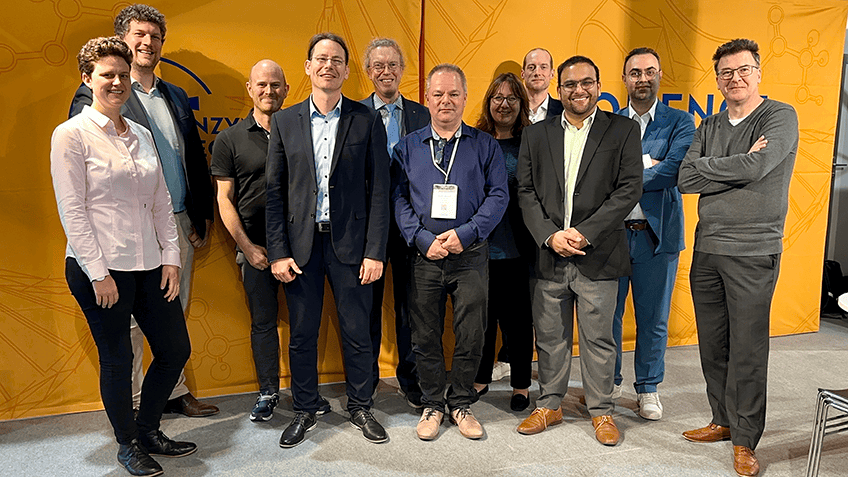
Representatives of the Enzyme Technology Alliance member companies gathered at CPHI Barcelona, showcasing the collaborative spirit of this innovative biotech partnership

Representatives of the Enzyme Technology Alliance member companies gathered at CPHI Barcelona, showcasing the collaborative spirit of this innovative biotech partnership

The Alliance's approach signifies a new way of problem-solving in the biotech industry. By offering comprehensive access to protein development processes, it enables global startups and corporations to bring their innovations to market more efficiently.

The collaboration can help accelerate advancements in biotechnology, potentially leading to breakthroughs in fields such as medicine, agriculture, and environmental sustainability and embracing a more cooperative and supportive partnership.

Broad expertise in research, development, and manufacturing is essential for the successful journey from protein sequence to a final biocatalytic process intended for large-scale implementation.

How ETA solves enzyme development challenges

ETA was founded to address the growing need for integrated, sustainable, and scalable enzyme-based solutions in industries like pharmaceuticals, chemicals, and biotechnology. Enzymes offer a greener alternative to traditional chemical processes, but developing them efficiently requires expertise across multiple disciplines.

By combining the strengths of specialized companies, ETA:

  • Accelerates time-to-market for enzyme innovations.

  • Reduces complexity in R&D and scale-up.

  • Offers sustainable alternatives to harmful chemical processes.

  • Supports circular economy principles by enabling biocatalytic production.

In short, ETA was created to make enzyme development faster, smarter, and more environmentally responsible.

SpinChem's contribution to enzyme optimization

For companies in biotech, pharmaceutical, chemical and other process industries struggling with slow, inefficient enzyme processes and costly scale-up challenges, SpinChem's innovative Rotating Bed Reactor (RBR) technology significantly improves mass transfer and reduces process time. RBR technology helps to eliminate common challenges like enzyme degradation, long reaction times, and poor yields in heterogeneous reactions.

At SpinChem, our commitment is not just technical; it's part of a larger vision to contribute to a more sustainable future. With the Alliance, we can make a difference in the world. Being relatively small companies, we are also flexible and agile, able to adapt and respond quickly to market needs.

Biocat 2026

Meet SpinChem at Biocat 2026, the 12th International Congress on Biocatalysis, where the global biocatalysis community meets to share advances in enzyme catalysis and industrial bioprocess development. SpinChem will participate as part of the Enzyme Technology Alliance (ETA), a collaboration that brings complementary expertise across the journey from enzyme discovery and engineering to immobilization and scalable process implementation. Learn more about the Enzyme Technology Alliance We will be available to discuss how rotating bed reactor (RBR) technology supports scalable, reproducible biocatalysisby improving mass transfer while keeping solids protected and contained. Practical approaches to enzyme immobilization and multi-cycle reuse Catalyst compartmentalization for multi-step or incompatible catalyst setups Scale-up pathways from lab to production with consistent processing logic Event details Dates: August 23–27, 2026 Location: Hamburg University of Technology (TUHH), Hamburg, Germany Official event page: https://biocat-congress.de/ Meet SpinChem Interested in exploring how RBR technology could support your biocatalysis route or scale-up plans? Contact us to schedule a meeting in Hamburg.

23 Aug 2026 - 27 Aug 2026

Hamburg, Germany

12:00 - 12:00

OxiZymes 2026 Bochum

Meet SpinChem at OxiZymes 2026, the 12th edition of the OxiZymes conference series covering Enzyme Mining and Engineering Enzymology and Biochemistry Biotechnology and Applications You can meet SpinChem at the conference to discuss and discuss how rotating bed reactor (RBR) systems can support biocatalysis processes by improving gas–liquid–solid mass transfer, enabling catalyst compartmentalization, and simplifying reuse of immobilized enzymes. Event details Dates: September 29 – October 2, 2026 Location: Ruhr-Universität Bochum, Bochum, Germany Official event page here If you are attending OxiZymes 2026 and want to discuss enzyme immobilization, scale-up logic, or practical evaluation setups, contact us to arrange a meeting in Bochum.

29 Sep 2026 - 02 Oct 2026

Ruhr-Universität Bochum

12:00 - 12:00

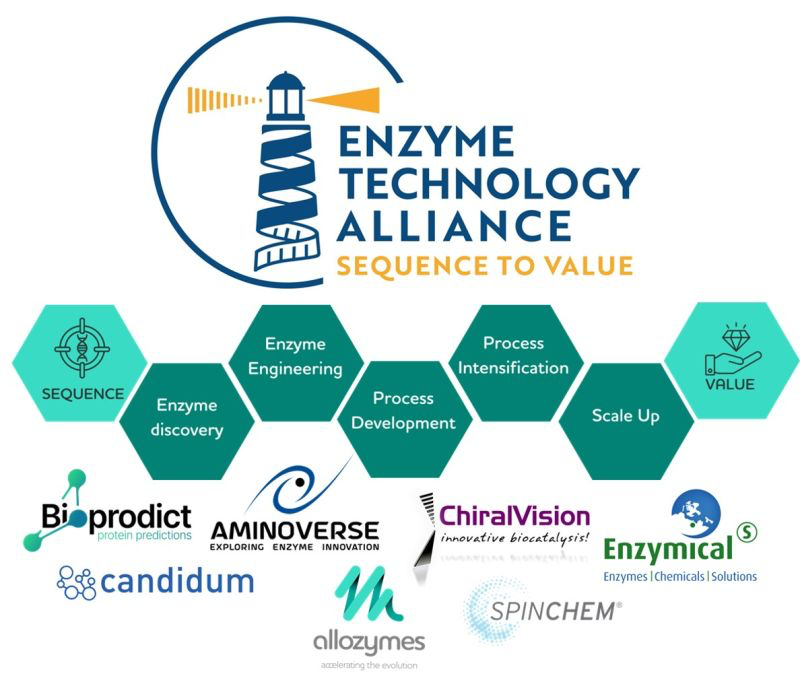
Enzyme Technology Alliance capabilities from sequence to value

Together, the ETA members offer a seamless integration of services across the enzyme development pipeline

  • Enzyme Discovery – Utilizing bioinformatics and modeling to identify potential enzymes.
  • Enzyme Engineering – Applying AI and computational tools for enzyme optimization.
  • Process Development – Developing and optimizing enzymatic processes for industrial applications.
  • Process Intensification – Enhancing reaction efficiency and scalability through advanced technologies.
  • Scale-Up – Transitioning from laboratory-scale processes to full-scale manufacturing.

Current Members of the Enzyme Technology Alliance


Members of Enzyme Technology Alliance
Logos of the members of the Enzyme Technology Alliance


As of October 2024, since Bio-Prodict's joining of the ETA, it comprises the following seven specialized biotech companies:

1. Allozymes, Singapore – Utilizes proprietary microfluidics technology to perform ultra-high-throughput enzyme screening (up to 10 million variants per day). This accelerates the discovery and development of custom enzymes for applications such as active pharmaceutical ingredient (API) production.

2. Aminoverse B.V., The Netherlands – Focuses on early-stage enzyme innovation, combining wet-lab expertise with AI-driven tools like EnzyMAP and EnzyREC. They offer extensive libraries of unspecific peroxygenases and ketoglutarate-dependent oxygenases for rapid screening and development.

3. Bio-Prodict B.V., The Netherlands – Provides AI-powered protein engineering through its 3DM Engineering platform, which streamlines protein design and optimization. Their tools assist in intelligent protein selection, targeted mutations, and iterative optimization, while also offering integrated intellectual property (IP) navigation.

4. Candidum GmbH, Germany – Specializes in computational enzyme design, creating custom enzyme solutions by integrating computational methods to reduce complexity and enhance predictability in enzyme development.

5. ChiralVision B.V., The Netherlands – Offers expertise in enzyme immobilization and process development, facilitating the transition from enzyme discovery to scalable production processes. 

6. Enzymicals AG, Germany – Provides services in enzyme production and process development, supporting projects from initial catalyst discovery to full-scale manufacturing, including current Good Manufacturing Practice (cGMP) production of APIs.

7. SpinChem AB – Develops Rotating Bed Reactor (RBR) technology, enhancing chemical reactions by improving efficiency and sustainability. SpinChem's Rotating Bed Reactor technology significantly enhances process intensification and scalability due to its clever concept - the rotating packed bed actively forces liquid through immobilized materials, leading to superior mass transfer rates and more efficient chemical processes compared to traditional reactors.

Find out more about the Alliance here

Frequently asked questions

What is the Enzyme Technology Alliance and what does it do?

The Enzyme Technology Alliance (ETA) is a collaborative group of seven innovative biotech companies that work together to develop and scale up sustainable enzyme solutions. The alliance combines expertise in enzyme discovery, engineering, and process development to help companies bring innovative biotech products to market faster and more efficiently.

Who are the current members of the Enzyme Technology Alliance?

The Enzyme Technology Alliance comprises seven specialized biotech companies: Allozymes (Singapore), Aminoverse B.V. (Netherlands), Bio-Prodict B.V. (Netherlands), Candidum GmbH (Germany), ChiralVision B.V. (Netherlands), Enzymicals AG (Germany), and SpinChem AB (Sweden). Each member brings unique expertise in areas like enzyme screening, AI-driven tools, computational design, and process development.

How can SpinChem's RBR technology improve enzyme processes?

SpinChem's Rotating Bed Reactor (RBR) technology significantly improves enzyme processes by enhancing mass transfer rates and reducing process time. This innovative technology helps solve common challenges in enzyme reactions, including degradation issues, lengthy reaction times, and low yields, making industrial-scale enzyme processes more efficient and cost-effective.


What are the benefits of working with the Enzyme Technology Alliance?

Working with the Enzyme Technology Alliance provides access to comprehensive enzyme development services, from initial discovery to full-scale production. Companies benefit from combined expertise across multiple disciplines, faster development times, reduced R&D complexity, and sustainable solutions that can improve production profitability.

Willing to know more? Contact us today